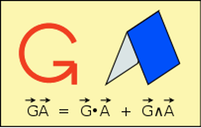
Previous section: Introduction to Geometric Algebra and Basic 2D Applications.
Next section: Rotors and Rotations in the Euclidean Plane.
The algebraic properties of vector addition and scalar multiplication are insufficient to characterize the geometric concept of a vector as a directed line segment, because they fail to encode the properties of magnitude and relative direction. That deficiency is corrected by defining suitable algebraic rules for multiplying vectors.
Geometric product: The product ab for vectors a, b, c is defined by the rules
• Associative: (ab)c = a(bc)
• Left distributive: a(b + c) = ab + ac
• Right distributive: (b + c)a = ba + ca
• Euclidean metric: a2 = a2,
where a = |a| is a positive scalar (= real number) called the magnitude of a.
In terms of the geometric product ab we can define two other products, a symmetric inner product
(1) a∙b = ½(ab + ba) = b∙a
and an antisymmetric outer product
(2) a∧b = ½(ab − ba) = − b∧a
Adding (1) and (2), we obtain the fundamental formula
(3) ab = a∙b + a∧b called the expanded form for the geometric product.
Our next task is to provide geometric interpretations for these three products.
Exercise: For a triangle defined by the vector equation a + b = c,
derive the standard Law of Cosines: a2 + b2 + 2a∙b = c2, and so prove that the inner product a∙b is always scalar-valued.
{Just multiply c2 = (a + b) (a + b) and use the Euclidean metric above and definition (1) above for the inner product.
Notice also that if a and b are perpendicular, using the Pythagorean Theorem we can conclude a∙b is zero (and vice versa).
Further, if a and b are perpendicular, using formulas (1) & (2) above, a∧b = ab = ½(ab − ba), which means ab = − ba.}
Therefore, the inner product can be given the usual geometric interpretation as the length of a perpendicular projection of one line segment on the direction of another.
The outer product a∧b = − b∧a generates a new kind of geometric quantity called a bivector, that can be interpreted geometrically as directed area in the plane of a and b.
We have shown that the geometric product interrelates three kinds of algebraic entities: scalars (0-vectors), vectors (1-vectors), and bivectors (2-vectors) that can be interpreted as geometric objects of different dimension. Geometrically, scalars represent 0-dimensional objects, because they have magnitude and orientation (sign) but no direction. Vectors represent directed line segments, which are 1-dimensional objects. Bivectors represent directed plane segments, which are 2-dimensional objects. It may be better to refer to a bivector
as a directed area, because its magnitude B = |B| is the ordinary area of the plane segment and its direction
represents the plane (and orientation) in which the segment lies, just as a unit vector represents the direction of a line. The shape of the plane segment is not represented by any feature of B, as expressed in the following equivalent geometric depictions for B (with counterclockwise orientation):
Prove the following:
Given any non-zero vector a in the plane of bivector B, one can find a vector b such that
B = ba = –ab,
B2 = −|B|2 = −a2b2,
aB = –Ba, that is, B anticommutes with every vector in the plane of B.
{Looking again at the depictions directly above, it should be clear we can pick a b perpendicular to a
and also in the plane of B so that the rectangle depicting b∧a has the magnitude and orientation of B.
Further, since we've picked b to be perpendicular to a, by the arguments in the exercise above,
B = b∧a = ba = – ab. Then, B2 = (–ab) (ba) = – a2b2 = − a2b2 = −|B|2 < 0.
Finally, aB = – aab = − a2b = − baa = – Ba.}
Every vector a has a multiplicative inverse:
that is, geometric algebra makes it possible to divide by vectors.
{Simply multiply a on either side by a/a2. As usual, we must assume a≠0.}
Prove the following theorems about the geometric meaning of commutivity and anticommutivity:
a∙b = 0 ⇔ ab = −ba Orthogonal vectors anticommute!! {See the exercise above.}

a = λb ⇔ a∧b = 0 ⇔ ab = ba Collinear vectors commute!!

The problem remains to assign geometric meaning to the quantity ab without expanding it into inner and outer products.
Previous section: Introduction to Geometric Algebra and Basic 2D Applications.
Next section: Rotors and Rotations in the Euclidean Plane.