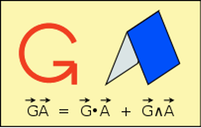
Previous section: General Kinematic Theorem.
Next section: Planar Rigid Body Motion and Reference Frames.
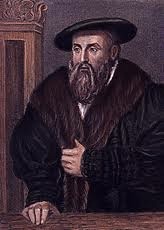
Johannes Kepler
(1571 - 1630)
General Keplerian motion under an inverse square force.
Reference:
NFCM {= New Foundations in Classical Mechanics, 2nd Ed., 1999}, Chapter 4.
(1) Dynamical model:
(2) Problem: Reduce to algebraic model by finding constants of motion.
(a) Angular momentum:
(b) Eccentricity vector ε in:
Hints [See link under part (3), below, for more detail.]:
(3) Model analysis. Derive the following algebraic features of the model.
[Details are fully worked out in NFCM and see link below for more detail and an example.]
(a) Energy
is constant and related to eccentricity and angular momentum by
(b) Orbit:
[Note: orbit is not a trajectory, which gives position as a function of time.]
(c) Hodograph:
Show this is a circle by deriving the non-parametric equation (u is the hodograph center, see below)
(d) Classification of orbits (by eccentricity, energy & hodograph center u):
Circle: ε = 0 E = - mk2/(2L2) u = 0
Ellipse: 0 < ε < 1 E < 0 u < |k|/L
Parabola: ε = 1 E = 0 u = |k|/L
Hyperbola: ε > 1 E > 0 u > |k|/L
(e) Initial value problem: Determine L and ε given m, k, and one concurrent value of v and r.
(Click here for more derivation details and an example of elliptical orbit with associated hodograph.)
(4) Scattering problem: Given asymptotic initial velocity and angular momentum, find vf = vfinal.
(a) Asymptotic conditions:
(b) Eccentricity conservation:
This solves the scattering problem completely!!
The remaining problem is to reformulate it in terms of observed quantities:
Scattering angle Θ and impact parameter b are defined and related as follows:
which is the relationship known from Rutherford scattering (Coulomb scattering)!
Previous section: General Kinematic Theorem.
Next section: Planar Rigid Body Motion and Reference Frames.