Previous section: Special Relativity with Geometric Algebra.
Next section: Spacetime Maps.
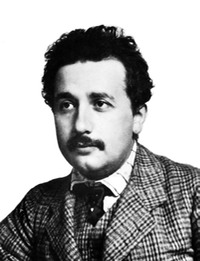
Einstein (1905) recognized that Newtonian mechanics is inconsistent with Electromagnetic Theory, and he traced the difficulty to the Newtonian concept of time. He resolved this problem by adopting two principles:
1. Principle of Relativity. Einstein adopted this principle from Newtonian theory, but raised
its status from a mere corollary to a basic principle.
2. Invariance of the speed of light. Einstein assumed that the speed of light c has the
same value in all inertial systems.
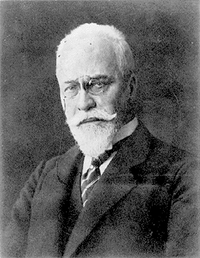
Minkowski (1908) incorporated these principles into a new conceptual fusion of space and time that can be defined with GA by the following assumptions:
1. In a given inertial system, the time t and place x is of an event is represented as a single
point X = ct + x in a 4-dimensional space called spacetime (see spacetime maps below).
2. The spacetime displacement
∆X = X2 − X1 = c (t2 − t1) + (x2 − x1) = c∆t + ∆x
between events X1 and X2 has an invariant magnitude |∆X| called the interval or
proper distance between the events and given by
∆X ∆X̃ = ε |∆X|2 = (c∆t)2 − (∆x)2 ,
where ∆X̃ = c∆t − ∆x, and the signature ε of the interval has the value 1, 0 or –1, and,
respectively, the interval is said to be timelike, lightlike, or spacelike.
3. Invariance of the interval means that
∆X ∆X̃ = ε |∆X|2 = ε |∆X'|2 = ∆X' ∆X̃'
where ∆X' = X'2 − X'1 = c∆t' + ∆x' is the same interval represented in some other inertial
system.
Problem: Prove that spacetime interval invariance implies that the speed of light c has the same
constant value in all inertial systems.
(Click here for a solution to this problem.)
Footnote: Because of the importance of c in this theory and the mountain of experimental data
supporting the theory, its value is now defined to be c ≡ 299,792,458 m/s. The
second is defined in terms of the period of radiation emitted from a certain energy
level transition in 133Cs at absolute zero. Then, with the given value for c, the
meter is defined as the length traveled by light in (1/299,792,458) seconds ≈ 3.34 ns.
The combined quantity ct shows up naturally in these equations, is used in the
spacetime diagrams on following pages, and has the units of meters. It is a useful
practice to think of ct as representing meters of time or time meters. We say one
time meter (ct = 1) corresponds to a time of about 3.34 ns.
Previous section: Special Relativity with Geometric Algebra.
Next section: Spacetime Maps.